
Job Description Template
Write a clear work description in minutes. Fill in the role, summary, key responsibilities, requirements and working conditions — the builder formats everything into a professional job description you can copy into a job board, print or save as a PDF.
- Free to use
- No sign-up
- Runs in your browser
Build a work description
Job Description Template Library
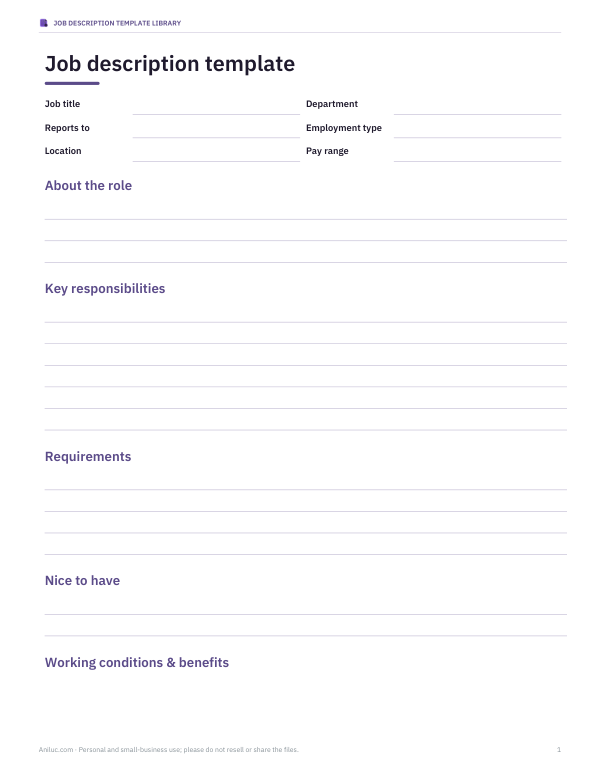
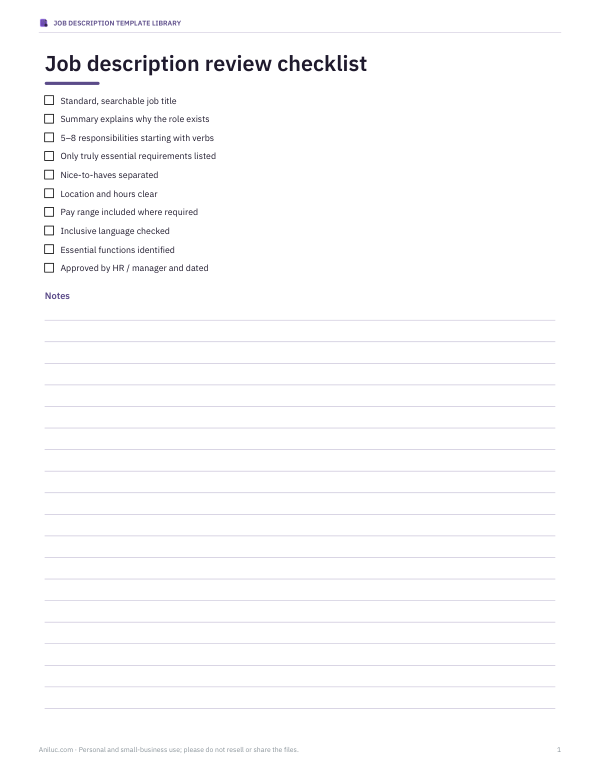
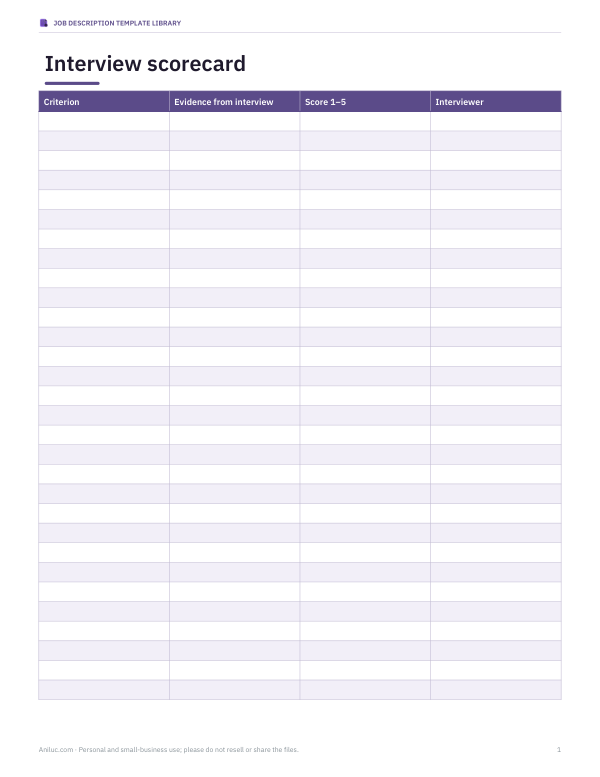
Twenty editable job description templates for common small-business roles, plus a job description review checklist and an interview scorecard.
- 20 role templates (DOCX, PDF)
- Review checklist (PDF, DOCX)
- Interview scorecard (PDF, DOCX, XLSX)
Formats: DOCX, PDF, XLSX. Instant download after payment (link valid 72 hours, up to 5 downloads). AI-assisted: the templates were drafted with AI help and reviewed and laid out before publishing.
$5.00 USD, one-time 3 files · about $1.67 each
- Instant download
- 7-day refund
- Secure checkout by Stripe
7-day money-back guarantee. Full refund within 7 days of purchase, even after you download.
Full refund within 7 days — see the refund policy and license.
Free printables
Single sheets you can print right now, no sign-up. The full pack adds every sheet in one download plus the editable files.
What a work description is for
A work description — usually called a job description — explains what a role is for, what the person will do, what they need to bring and the conditions of the job. It does double duty: in recruitment it attracts the right applicants and helps them decide whether to apply, and once someone is hired it sets expectations, guides training and performance reviews, and supports decisions about pay grades and legal classification. A good one is specific, honest and short enough to read on a phone.
The sections to include
| Section | What to write | Tip |
|---|---|---|
| Job title | A clear, commonly used title | Avoid internal jargon or “ninja”-style titles; people search for standard titles |
| Summary | Why the role exists and its main purpose | 2–3 sentences, written to the reader (“you will…”) |
| Responsibilities | The 5–8 main duties | Start each with a verb; put the most important first |
| Requirements | Skills, experience and qualifications that are truly essential | Keep the list short; extra requirements deter good applicants |
| Nice to have | Helpful but optional extras | Separating these encourages a wider range of applicants |
| Working conditions | Hours, location, travel, physical demands | Be clear about remote or hybrid arrangements |
| Pay and benefits | Salary range, key benefits | Several US states and cities require pay ranges in postings |
| Equal opportunity statement | Your organisation's commitment and accommodation contact | Use your approved wording |
Writing clear responsibilities
- Begin with an action verb: “Respond”, “Prepare”, “Maintain”, “Coordinate”.
- Describe outcomes, not just activities: “Resolve billing questions on first contact” says more than “Answer phones”.
- Include how often or how much where it matters: “Prepare monthly sales reports”.
- Mention tools and systems only if they are genuinely required.
- Group minor tasks into one line rather than listing everything.
Requirements that do not exclude good candidates
Every requirement you add shrinks the pool of applicants, and research on job ads suggests many people do not apply unless they meet nearly every listed requirement. Ask of each line: would we really reject an otherwise strong candidate without it? If not, move it to “nice to have”. Consider whether a degree is truly necessary or whether equivalent experience would do. Use inclusive, plain language, and avoid terms that imply age, gender or other protected characteristics.
Worked example
For a customer support specialist, the builder produces a heading with the title and a line of key facts — department, full-time, hybrid location and pay range — followed by a three-sentence summary, five responsibilities starting with verbs, four essential requirements, two nice-to-haves and the working hours and benefits. The equal opportunity placeholder reminds you to add your organisation's approved statement. The result is about 250 words: long enough to be informative, short enough to read on a phone.
Legal considerations
Job descriptions are not usually required by law, but what they say matters. In the United States, the essential functions of a job can be relevant under the Americans with Disabilities Act, and duties influence whether a role is exempt or non-exempt from overtime under the Fair Labor Standards Act — a decision based on actual duties and pay, not the title. Pay transparency laws in several states and cities require salary ranges in job postings. Rules differ in other countries. Have HR or an employment adviser review descriptions used for hiring and classification.
Keeping descriptions up to date
Roles change. Review each description at least once a year, when someone leaves, and when responsibilities shift. Ask the current job holder and their manager what has changed. An accurate description makes performance reviews fairer and helps when you next recruit. Store the approved version with a date so you know which one was used for each hire.
Adapting descriptions for different kinds of roles
Hourly and shift roles benefit from specifics about schedules, physical requirements such as lifting or standing, and any licences or certifications needed, for example a food handler card or a commercial driver’s licence. Professional roles benefit from a clearer picture of scope: who the person reports to, whether they manage others, budgets they control and the stakeholders they work with. Remote roles should state any time-zone requirements, travel expectations and equipment provided. In every case, keep the language concrete and avoid buzzwords that could mean anything.
Using the builder output
Copy the plain text into job boards and applicant tracking systems that do not accept formatting, or copy the HTML into systems and careers pages that do. Print or save as PDF for internal files and interview packs. Nothing you type is stored; the page keeps the description only while it is open.
Frequently asked questions
How long should a job description be?
Typically 300–700 words. Long enough to be clear, short enough to read quickly.
What is the difference between a job description and a job posting?
The description defines the role; a posting is an advertisement that often includes the description plus information about applying and the organisation.
Should I include the salary?
Including a range attracts better-matched applicants, and several US states and cities require it.
How many responsibilities should I list?
Usually five to eight main duties.
Is my text saved?
No. It stays in your browser until you close the page; print or copy it to keep it.
Does the job title decide overtime eligibility?
No. In the US, exempt status depends on duties and pay under federal and state rules, not the title.
Can I use the same description for internal and external postings?
Usually yes, with an added paragraph about your organisation and how to apply for external candidates.